
The Power of Emotional Intelligence Training and Corporate Coaching Services in Transformational Leadership
There is a kind of meeting most senior teams recognise but rarely name. The agenda is clear. The strategy is sound. And yet the room feels tight. People speak a little faster than usual. Eye contact drops. Someone keeps steering the conversation back to what they control, as if control itself might steady things.
The transformation plan will not fail because of what is written on the slide.
It will fail because of what is happening in this room.
What limits transformational leadership is rarely strategy. It is whether leaders can remain steady when conditions stop behaving. When plans meet friction. When uncertainty lingers. When resistance shows up as silence rather than objection.
This is where emotional intelligence training becomes real. Not as a concept, but as something visible in behaviour. Leaders begin to notice how quickly they interrupt when anxious. How fast they try to resolve ambiguity. How easily tension in the room gets mistaken for disagreement rather than reflection.
At Evolve, this work begins with leaders looking at their own patterns through assessment and then tracing those patterns back to real moments. Real meetings. Real decisions. Real conversations where the room shifted because of how they showed up without them realising it at the time. Coaching then moves from theory to observation. Leaders don’t discuss behaviour in abstract terms. They revisit situations that have already happened and learn to see what they missed while they were in it.
Over time, something subtle changes. Leaders begin to notice themselves while they are in motion. They feel the urge to rush and choose to slow down. They sense defensiveness rising and decide to listen instead. They learn to sit in a room where answers are not immediate without trying to force certainty simply to relieve discomfort.
Where AQai makes this even more measurable and more honest
Emotional intelligence explains what happens in the room. AQai (Adaptability Intelligence) explains why it keeps happening—and what capacity must grow for change to stick.
Most transformation efforts fail in the same place: the moment certainty disappears. The plan doesn’t break first. People do. They either tighten… or they expand.
That is why we measure adaptability through three areas:
• Ability — how well people can shift thinking and behaviour
• Character — how people respond emotionally and mentally under pressure
• Environment — how much the system supports or suffocates follow-through
This matters because a leadership team can look confident on paper and still be fragile under strain. AQai gives leaders language for the unseen mechanics: why people revert, why meetings become defensive, why “alignment” turns into quiet compliance.
What we’re seeing across multiple clients: SC and DI patterns
When we look at senior teams across multiple clients, a clear theme shows up:
Many SC (Steady–Compliant) profiles score lower in the Ability domain, particularly in:
• Unlearning — letting go of what used to work
• Mental Flexibility — switching approaches without feeling like they’ve “lost control”
• Mindset — staying open, optimistic, and resourceful when conditions shift
These leaders are often deeply reliable and consistent. They stabilise teams. They protect standards. But under rapid transformation, the same strength can become caution, delay, and over-control—especially when ambiguity rises.
In the Character domain, SC profiles often land medium on Hope (Ho), which means they can lean toward doubt and uncertainty when the path isn’t clear. Not because they lack competence—but because they dislike gambling with credibility. They prefer confidence that is earned through clarity, not forced through charisma.
On the other side, DI (Dominant–Influential) profiles may score higher in Character areas like Grit and Resilience. They tend to push through friction and keep moving. That drive is valuable—until it becomes a pressure wave.
Here is where the dynamic becomes delicate:
When DI leaders move too fast, speak too strongly, or “solve” too quickly, SC leaders can become more uncertain, not less. The room tightens. SCs withdraw into safety, data, and control. DIs interpret the quiet as resistance or lack of urgency. Then they push harder. And the cycle repeats.
The room doesn’t become tense because people disagree.
The room becomes tense because people are adapting at different speeds.
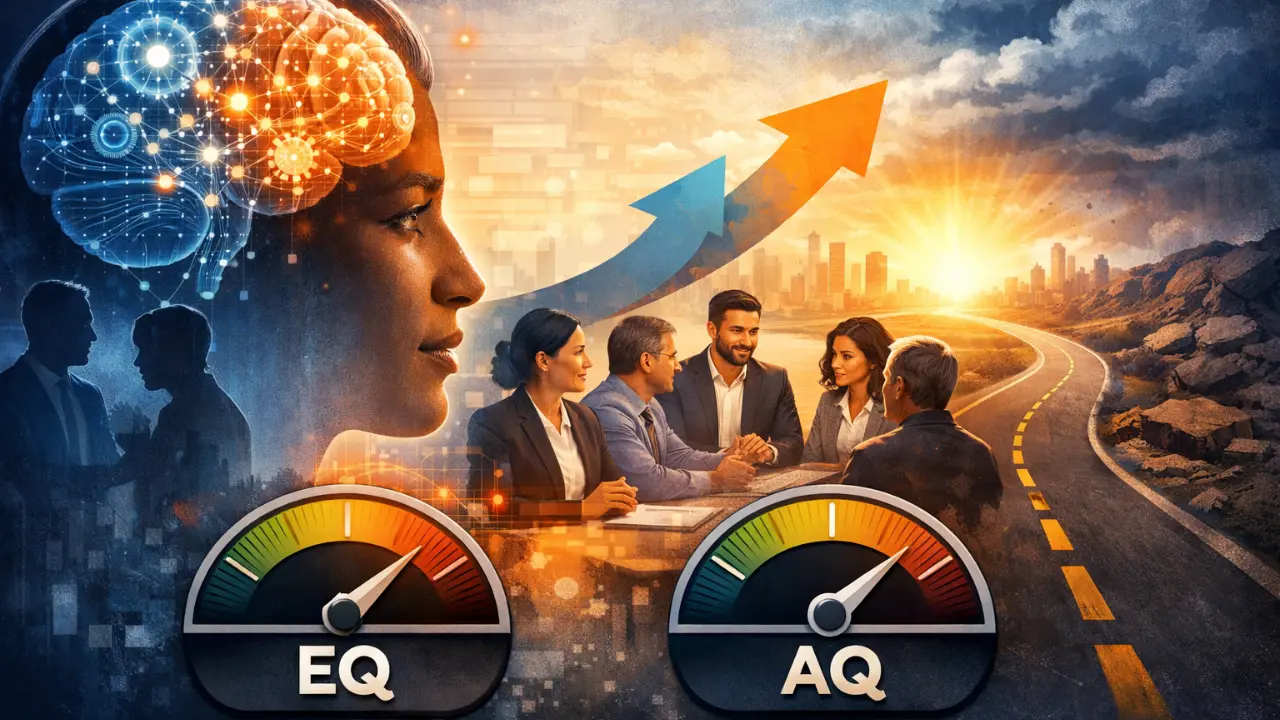
Transformational leadership is not only EQ. It is AQ + EQ together.
EQ allows a leader to sense what is happening emotionally. AQ allows a leader to stay effective when the emotional temperature rises.
Leaders who struggle with adaptability often push for resolution too early. They need the plan to work exactly as designed because deviation feels like failure. That rigidity travels through the organisation. Teams respond by becoming cautious, offering only what feels safe.
And this is why transformation consulting frameworks, change management plans, and operational roadmaps can still collapse. The design might be excellent. The humans implementing it might be overwhelmed by uncertainty and reacting instead of adapting.
You can have the most carefully designed transformation consulting framework and the most thoughtfully sequenced change management plan. If the leaders implementing it cannot hold uncertainty without becoming reactive, the design becomes irrelevant.
The real value of AQai in coaching: you stop guessing what the team needs
AQai allows coaching to move from general to specific. It answers questions like:
• Do we need to build Ability (unlearning and flexibility), not “motivation”?
• Do we need to build Character (resilience and hope), not “discipline”?
• Do we need to fix Environment (support, pressure, clarity), not “attitude”?
Once leaders can see where the real gap sits, coaching becomes practical. Not inspirational. Not theoretical. Real.
Strengths work becomes sharper when paired with AQai
Strengths work begins once leaders see these patterns clearly. Using Gallup CliftonStrengths, they start to understand how their natural talents help them in stable conditions and how, under strain, those same strengths begin to limit the room.
Someone strong in Strategic thinking may begin overthinking. Someone high in Command may become overpowering without intending to. Leaders learn when to lean into their strengths and when to soften them so others can contribute.
When AQai is added, leaders can also see which strengths are being squeezed by low adaptability—and which strengths can be used as levers to strengthen adaptability.
Team building stops being “bonding” and becomes behavioural clarity
Team building consulting informed by this insight stops being about trust exercises and starts being about examining how teams actually function when time is short and stakes are high. Where communication breaks down. Which patterns repeat under stress. Which behaviours quietly close the room.
And then something changes.
The same tight meeting room begins to feel different. People speak at a more measured pace. Silence is allowed to mean thinking rather than resistance. Disagreement surfaces without tension rising immediately. Decisions slow just enough to become thoughtful rather than reactive.
The transformation plan did not change.
The people in the room did.
That is the quiet effect of emotional intelligence training and corporate coaching services. They do not add new knowledge. They build the capacity to use what leaders already know when conditions are difficult and the stakes are real.
Leadership, in the end, is not a position. It is a quality of presence that either expands what feels possible for others or gradually narrows it. And that determines whether change survives contact with reality.